
Lawrence County Civil Docket Searches
Match the matter to its court first. Lawrence County Court of Common Pleas General Division takes civil claims exceeding $15,000. The Clerk opens public case information through eServices eAccess. Lawrence County Municipal Court covers civil complaints up to $15,000 and small claims up to $6,000, and it hears evictions in its territory via its CaseLook gateway. Ironton Municipal Court runs a separate lookup through its own civil record search. Probate keeps estates, guardianships, adoptions, and name changes in its own CaseLook channel. Wait, use the Common Pleas portal only for that court's cases.
Gather a court name, case number, caption, filing date, and a short description of the record before you call. A portal result traces the chronology, but the court holds the actual file. Need a certified copy? Want a plain copy or an older Lawrence County record? Contact the clerk who keeps it. The Common Pleas Legal Department handles that court's legal records at (740) 533-4355. Municipal, Ironton, and Probate files each go through their own offices.
- Identify the court from the caption, filing, hearing notice, or case number.
- Use that court's official public portal or clerk channel.
- Search by name or case number, and refine by case type or date when the portal permits it.
- Read the dates, docket entries, hearing field, and final entry in sequence.
- Request the particular document or certified copy from the record keeper when needed.
Lawrence County $15,000 Civil Docket Split
The $15,000 line drives the first routing call in Lawrence County. Common Pleas General Division claims original civil jurisdiction over matters exceeding that figure. The county Municipal Court caps civil complaints at $15,000, small claims at $6,000, and hears evictions inside its territory. That split does not fold Ironton into the Chesapeake-based court. Ironton Municipal Court stands as its own court of record, with a distinct clerk, location, fee schedule, and case search for any Lawrence County docket lookup.
| Civil stream | Local docket keeper | Public lookup or fallback |
|---|---|---|
| Major civil matter over $15,000 | Common Pleas General Division / Clerk of Courts | Clerk eServices, Legal Department, or clerk office |
| Civil claim to $15,000, small claim to $6,000, or eviction in stated territory | Lawrence County Municipal Court | Municipal CaseLook or Chesapeake clerk |
| Ironton municipal civil matter | Ironton Municipal Court | Separate Ironton CaseLook or clerk |
| Probate subject matter | Lawrence County Probate Court | Probate CaseLook, clerk office, or focused request |
Transfers and appeals can spawn a second case number and a second docket in Lawrence County. Hang onto the original number, and ask the clerk whether a related or receiving-court number also exists.
Civil Dockets: What They Show
A Lawrence County civil docket is the dated ledger of the case. The municipal CaseLook inventory typically lists the court and case number, caption with party roles, filing and status dates, chronological entries, and hearing date, time, and type. It also shows any balance or financial amounts, plus judgment or disposition fields. The Common Pleas eAccess screen sits behind an acknowledgment before a session opens. Expect a login step rather than open dropdowns. Its official landing page confirms public computer-generated case information plus separate authorized-user eFiling.
| Case and caption | The court-assigned case number and party roles used to distinguish the civil file. |
|---|---|
| Opening entries | Complaint or petition, service, and filing-date information that establishes the case history. |
| Pleadings and motions | Answers, notices, motions, orders, and dated docket entries showing request and ruling activity. |
| Hearing field | The displayed date, time, and type of a setting, which may be superseded by a later entry. |
| Judgment area | Dismissal, default judgment, agreed disposition, judgment entry, or other resolution field. |
What you see online does not mean every complaint, answer, exhibit, or order image is free to view. The docket points you to the request; it is not the document itself.
Lawrence County Common Pleas Civil Docket eServices
For a Lawrence County Common Pleas civil case, eServices is the local public access route. It is not an Ohio statewide trial-court search. The clerk's landing page asks for a public-information acknowledgment. It also describes results as generated from computerized clerk records. Searches run by name, case number, case type, attorney, or ticket and citation. Civil case numbers follow a pattern like YYYY CI NNNNNN, which helps shape a query, though the court assigns the real number.
eFiling and public lookup serve different roles. The Lawrence County clerk limits eFiling to authorized users. Those users may also submit proposed orders through it. The public side needs no attorney account. If an online entry reads unclearly, call the Legal Department. Or stop by the Clerk of Courts at 111 South 4th Street in Ironton, or send a focused request naming the record type.
What Cases Fill the Civil Docket
Which civil cases appear depends on the receiving court. Common Pleas carries the higher-value civil stream and houses Domestic Relations services. The county Municipal Court takes the limited-jurisdiction civil stream, small claims, and evictions. Probate keeps a subject-matter docket of its own. A case type is more than a search label. It tells you which court, clerk, portal, and local rules govern access to the case file.
- Common Pleas civil matters exceeding the local $15,000 threshold.
- Common Pleas domestic-relations matters and related court services.
- Municipal civil complaints within the $15,000 ceiling.
- Municipal small claims within the $6,000 ceiling and eviction cases in the court's territory.
- Probate estates, trusts, guardianships, adoptions, minor settlements, name changes, birth corrections, and marriage licenses.
The official Common Pleas Domestic Relations page identifies the court's domestic-relations channel.
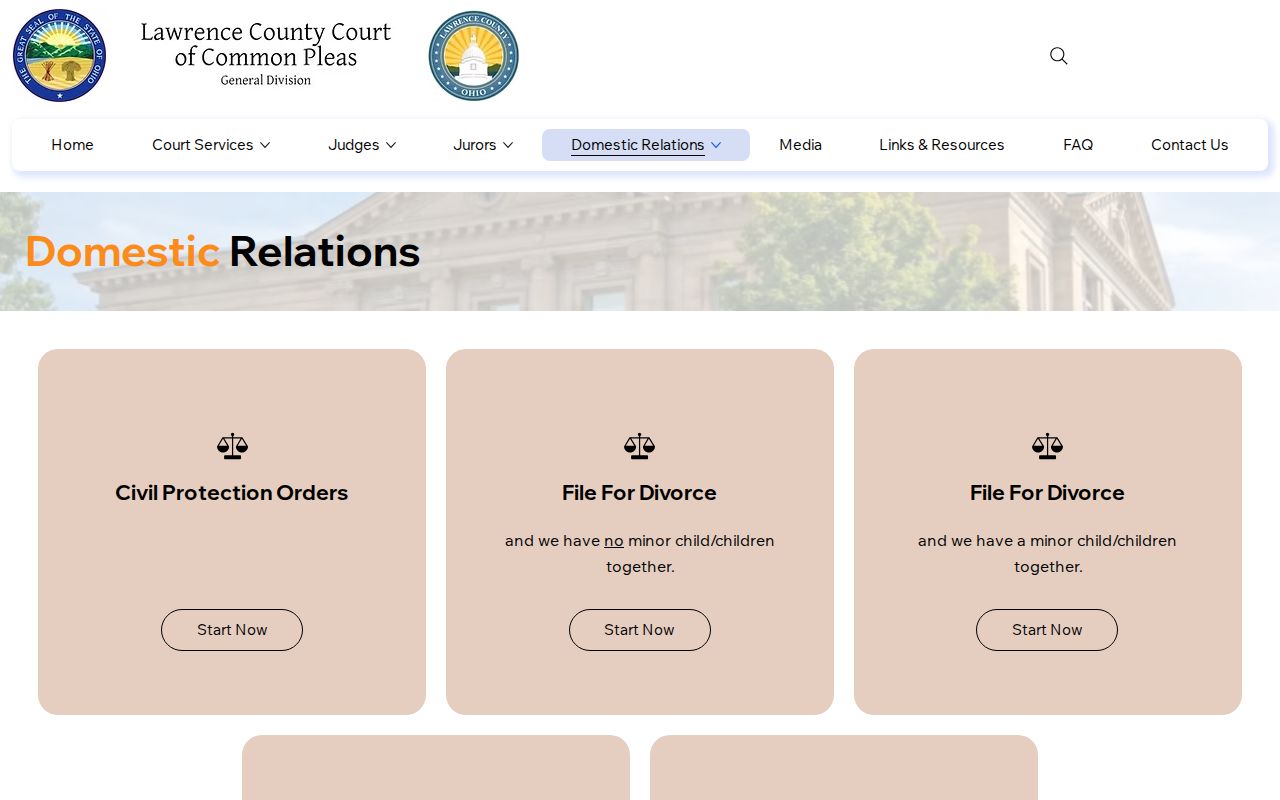
The court service described there fits only the Lawrence County Common Pleas civil and domestic context. No single public docket merges domestic, municipal, and Probate files.
Lawrence County Civil Docket Case Tracks
Lawrence County Common Pleas local rules sort cases into tracks: domestic, administrative-appeal, non-jury, jury, and other. So a docket entry may name a scheduling order, pretrial, mediation event, motion hearing, non-jury setting, jury setting, or final entry. It is rarely one generic court date. Read each label alongside the track and the entry date. A scheduling order shows how the court is managing the case. It is not automatically the trial date.
- Scheduling order
- An order setting deadlines or future case-management steps, not necessarily a final hearing date.
- Default judgment
- A judgment entered after the required conditions for default, confirmed by the judgment entry.
- Judgment entry
- The court's recorded decision, which differs from an online docket display.
- Continuance
- A docket entry moving or delaying a planned event; a later entry should be confirmed with the court.
The newest entry wins. When a case-management entry or continuance appears on the Lawrence County civil docket, it can push aside an older setting, so weigh the latest entry against the court notice and confirm the current date through the direct clerk channel.
Hearings on the Civil Docket
A hearing block on a Lawrence County civil docket may show a date, time, and hearing type. The docket history supplies the context around it. A complaint's filing date is not a hearing date. An early scheduling order, likewise, is not always the ultimate trial setting. On the Common Pleas civil docket, the tracks can include a motion hearing, pretrial, a mediation-related event, a non-jury setting, a jury setting, or a final entry. Municipal civil records follow their own CaseLook format. Spot the court first. Then read the newest dated scheduling entry. Portals warn that postings can lag a filing or action by at least 24 hours. If a setting looks stale, blank, or moved, call the Lawrence County court involved rather than treating the screen as real-time. Lawrence County Municipal Court answers at (740) 867-3127. Ironton Municipal Court takes calls at (740) 532-3062. For Common Pleas, use the court and Clerk Legal Department channels listed with its docket stream.
Lawrence County Civil Docket After Judgment
A judgment entry rarely ends the story. A Lawrence County case history can keep growing afterward. Ironton Municipal Court's current fee schedule lists separate post-filing processes for a certificate-of-judgment lien, garnishment, judgment-debtor examination, aid in execution, writ of restitution, replevin, transfer, and jury demand. Each term marks a distinct docket event and clerk process. None of them proves a judgment is enforceable today. Read the actual entry. Request the underlying order if its terms matter. A dismissal ends all or part of a claim only as the entry says. Voluntary dismissals can carry different wording. Confirm a default judgment from the judgment entry itself, never from a bare status label. An appeal or transfer can open a new docket at another court, so preserve both numbers and ask the court where the next record is kept.
Who Can See Civil Dockets
Ohio sets the rules for public court records. Access to Lawrence County civil dockets falls under Sup.R. 11.09-11.17, which covers public access, omitted personal identifiers, restrictions, redaction, and sealing procedures. The state's Public Records Act, R.C. 149.43, applies too, subject to its exceptions and to the court rules that govern files held by a court. So a record may be missing from a portal. A field may be redacted. A document may be restricted, and none of that establishes that no record exists.
Record-access rule: use the Lawrence County docket to identify the file, then ask the court holding it for the allowed copy or inspection process. Sealed and confidential material remains outside ordinary public access.
Lawrence County Probate Local Rule 55.1 offers one detailed county example. Open files can be examined right in the office. Retrieving a closed file can take up to ten court days. Plain copies at Probate run 10 cents per page. Certified, authenticated, or exemplified copies require at least one court day and advance payment. A mailed Probate request needs a self-addressed stamped envelope. Remember that these procedures and fees belong to Probate alone. They do not apply to every Lawrence County civil court.
Lawrence County Civil Docket Record Requests
Ask for the correct product. A Lawrence County docket history is a chronological locator. A filed case document is the real thing. It is the complaint, motion, order, judgment, exhibit, or paper held in the file. A certified, authenticated, or exemplified copy is prepared by the record keeper. It serves a use that requires certification. Give the court or division, case number, caption, document type, and approximate date. Before paying, ask one more thing. Is the record current, stored, restricted, or subject to redaction? Lawrence County Common Pleas Local Rule 3 has the clerk preserve action papers. It also directs the clerk to supply copies upon request for the usual fee. Check the Common Pleas fee PDF for current amounts. Ironton posts a court-specific certified-copy price of $3 per page and a $25 triple-seal certification. Do not carry those figures over to Common Pleas, Probate, or County Municipal. Confirm the current fee and payment method first. Submit the request only after the right Lawrence County court confirms them.